

The Energy Information Administration (EIA) recently announced that coal plant owners and operators expect to retire about 27 gigawatts of coal-fired capacity by 2016 — four times the 6.5 gigawatts of capacity retired between 2007 and 2011. In 2012, electric generators are expected to retire 9 gigawatts of coal-fired capacity, the largest amount of retirements in a single year in America’s history.
In 2011, there were 1,387 coal-fired generators in the United States, totaling almost 318 gigawatts. The 27 gigawatts of retiring capacity is 8.5 percent of total coal-fired capacity. The 2012 record retirements are expected to be exceeded in 2015 when nearly 10 gigawatts of coal-fired capacity are expected to retire. [i]
Most of the units retiring are located in the Mid-Atlantic, Ohio River Valley, and Southeastern United States as shown in the map below.

Source: U.S. Energy Information Administration, http://www.eia.gov/todayinenergy/detail.cfm?id=7290
Note: Capacity values represent net summer capacity.
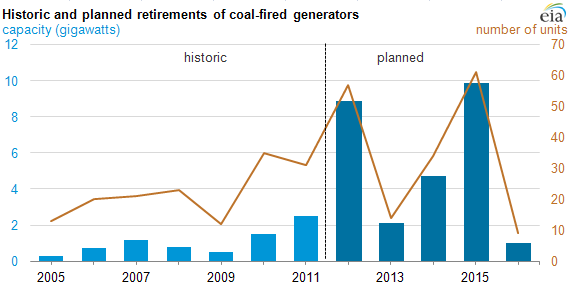
Source: U.S. Energy Information Administration, http://www.eia.gov/todayinenergy/detail.cfm?id=7290 Note: Data for 2005 through 2011 represent actual retirements. Data for 2012 through 2016 represent planned retirements, as reported to EIA. Data for 2011 through 2016 are early-release data and not fully vetted. Capacity values represent net summer capacity.
The EIA provides several reasons for the retirements, but the largest factor affecting coal-fired generating units are new regulations recently imposed by the Environmental Protection Agency (EPA). For example, the Mercury and Air Toxics Standards require the addition of costly environmental equipment, which will result in the retirement of the older, smaller units that are not used heavily because it is not cost effective to make the additional investment.
However, the table below shows that the coal-fired generators that are planned for retirement between 2012 and 2015 have an average size of 154 megawatts (MW)—more than twice the average size of the units retired during the 2009 to 2011 period, which had an average size of 59 megawatts. Twelve units of at least 200 megawatts are expected to retire in 2012, including two large 790 megawatt units. Another 13 coal-fired units with generating capacities of 200 megawatts or greater are expected to retire in 2015, which is close to the average size of all coal-fired units existing in 2011 (228 megawatts).
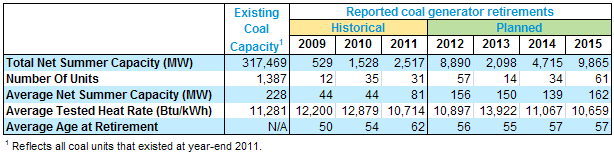
Source: U.S. Energy Information Administration, http://www.eia.gov/todayinenergy/detail.cfm?id=7290
Note: Data for 2009 through 2011 represent actual retirements. Data for 2012 through 2015 represent planned retirements, as reported to EIA. Data for 2011 through 2015 are early-release data and not fully vetted. Capacity values represent net summer capacity.
The table also shows that the plants that are planned for retirement are also more efficient than previously-retired plants. By 2015, the retiring coal-fired units will have average tested heat rates of about 10,700 British thermal units per kilowatt hour, which are about 12 percent more efficient, on average, than those units that retired during 2009 to 2011. But, they are about 5 percent less efficient than the average coal unit.
Please continue reading at:



 The EPA maintains State Resource Locators and contact information for several topics: Air Quality – Ambient











Connect with EHS News